
What Size Rug Under a Dining Table? The Complete Guide
Quick answer: Your dining rug should extend at least 60 to 75 cm beyond the edge of the table on all sides, so chairs remain fully on the rug even when pulled out — for a standard six-seater table, that usually means a 200 x 290 cm or 230 x 330 cm rug.
The Golden Rule for Dining Room Rugs
Here's the one rule that makes dining rug shopping simple: your rug should extend at least 60 to 75 cm beyond the edge of your table on all sides. This ensures that chairs remain fully on the rug even when pulled out for sitting.
When chair legs catch the edge of a rug, they wobble, scrape, and create an uneven surface that's frustrating for everyone at the table. Getting the size right eliminates this entirely.

Rug Sizes by Table Size
4-Seat Dining Table (approx. 120 x 80 cm)
A 200 x 290 cm rug is the ideal match. This gives you roughly 60 cm of rug beyond the table on every side — enough for chairs to slide in and out comfortably.
6-Seat Dining Table (approx. 180 x 100 cm)
Step up to a 240 x 340 cm rug. With a longer table, you need proportionally more rug to accommodate the extra chairs at each end. This size keeps everything balanced.
8-Seat Dining Table (approx. 220 x 110 cm)
You'll want a generous 300 x 400 cm rug. Large dining tables are a centrepiece, and a rug this size anchors the whole setting. It also protects a significant area of flooring from chair scratches.
Round Dining Tables
For round tables, use a round rug that's at least 60 cm wider in diameter than the table. A 120 cm round table, for example, needs a rug that's at least 240 cm in diameter. Round on round creates a beautiful symmetry that rectangular rugs can't match.
Shape Matching: Does It Matter?
Rectangular tables look best on rectangular rugs — that's the conventional wisdom, and it holds up. The parallel lines create visual harmony. However, a rectangular rug under a round table can also work well, especially in a room with strong linear architecture.
What rarely works is a round rug under a long rectangular table. The proportions feel off, and you'll end up with exposed corners where chair legs catch the rug's edge.

Style Tips for Dining Room Rugs
Think About Spills
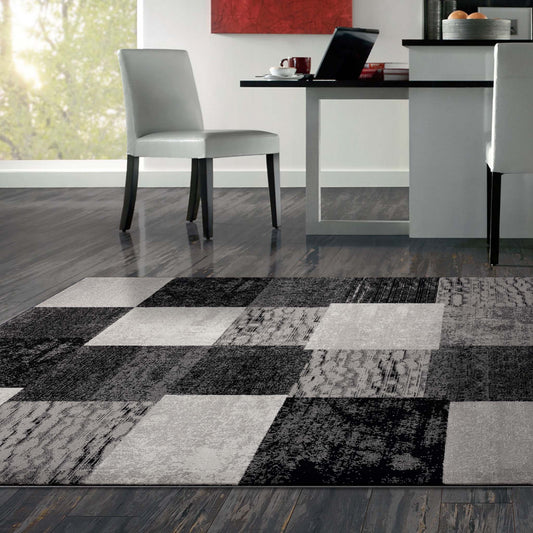
Dining rooms are high-risk zones for food and drink spills. A stain-resistant rug or a washable rug will save you significant stress. Dark colours and busy patterns also help camouflage minor marks between cleans.
Low Pile Is Your Friend
A low-profile rug makes it easier to slide chairs in and out. High-pile or shaggy rugs look gorgeous in living rooms, but they're impractical under a dining table where chairs are constantly being moved.
Consider the Room, Not Just the Table
Your rug should suit the overall room proportions. In an open-plan space where the dining area flows into the kitchen or lounge, the rug also serves as a visual zone marker. Make sure it's large enough to clearly define the dining area without crowding adjacent spaces.
Common Mistakes to Avoid
Going too small is the number one mistake. A rug that only fits under the table looks like an afterthought and creates the wobbling-chair problem. When in doubt, size up.
Ignoring the chair test: before buying, pull your chairs out to their fully seated position and measure from there. That's your minimum rug boundary.
Forgetting underlay: dining chairs put concentrated pressure on small points. A good underlay protects both the rug and your floor.

Quick Reference Table
4-seat table: 200 x 290 cm rug
6-seat table: 240 x 340 cm rug
8-seat table: 300 x 400 cm rug
Round table: Round rug, 60 cm wider than table diameter
With free delivery Australia-wide, finding the perfect dining rug has never been easier. Browse our full range of 200 x 290 cm, 240 x 340 cm, and 300 x 400 cm rugs to find the right fit for your table.